
The Tennessee State Senate in session
By now you know that the Tennessee General Assembly consists of two chambers and that it has the power to pass laws that can affect just about every aspect of your life.
Now we’re going to tell you much more “insidery” stuff. First we’re going to tell you a little about how the legislature is organized and about who these 132 state legislators are (click here to learn the names of your senator and representative).
We’re going to tell you about two types of people — lobbyists and reporters — who affect legislators and affect the way the general public perceives legislators. And we’re going to give you an example of a controversial bill, and explain the long course it took to become a law.
The committee system
The Tennessee General Assembly meets from late January until about May each year. During a typical session, members propose in the range of 2,000 bills (more on that later).
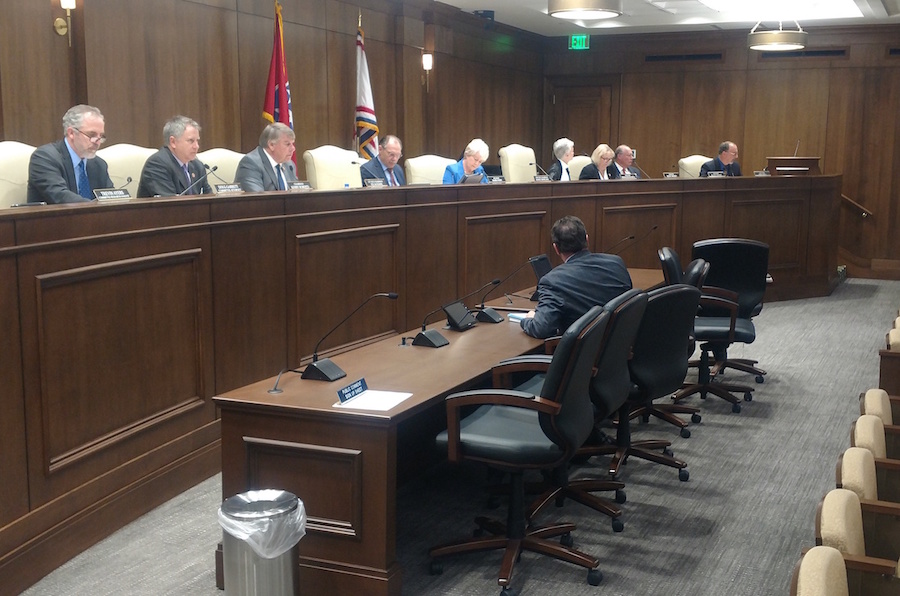
A committee of the legislature
Because there are so many bills, and because they cover such a wide range of issues, the legislature has set up a committee system that votes bills up or down before they are considered by the entire house or senate. Bills have to receive majority approval in committee before they will be considered by the house or senate.
We’re not going to list every committee. But we will point out, since it should be of interest to you, that both the house and senate have education committees. Any bill that would affect the operation of your school would in all certainty be sent to both the 17-member House Education Committee and the 9-member Senate Education Committee.
So let’s say, for instance, that you want the Tennessee General Assembly to pass a bill that gives every student a new school desk. To get this bill to pass, you write a House version and a Senate version and find someone in the House and Senate to sponsor the bill. A few weeks later the bill is sent to the House and Senate Education Committees. You need 9 votes in the 17-member House committee and 5 votes in the 9-member Senate committee.

The hallways of the Tennessee State Capitol are very crowded when the legislature is in session!
Assuming you get through the education committees, you still have another hurdle. You see, in order to keep tabs on how money is being spent, all bills that require the state to spend money have to also be passed by the House and Senate Finance, Ways and Means Committees.
If you get the bill through the committee system, you’ll of course have to get the bill to pass the full house and full senate. That means you are going to need 50 votes in the 99-member house and 17 votes in the 33-member senate. If you have somehow made it through all those committees, getting enough votes on the floor shouldn’t be much of a problem.
But make no mistake: Getting a bill to pass is a lot of work. It’s so much work that there are people who spend their entire lives trying to navigate the process. They are called lobbyists, and we’ll talk more about them in a while.
Today the Tennessee General Assembly is kind of an unpredictable place. Regardless of whether they are Republican or Democrat, regardless of which part of the state they come from, individual legislators can make a difference. They can, and do, show up every year with new ideas and have their ideas seriously considered by their colleagues and by the governor.
But it hasn’t always been like this. Click here to see how things have changed.