Teacher’s Guide to Don’t Keep Them in Doubt (2027 Edition)
Welcome to the teacher’s guide to the 2027 edition of the 11th grade Tennessee History for Kids workbook Don’t Keep Them In Doubt.
Since the standards for the U.S. history class didn’t change very much between 2019 and 2017, this booklet can be used regardless of whether you are teaching the 2019 or 2027 standards. The only major topic that is moving away from the U.S. history class is the Coal Creek saga, which is moving to the fifth grade Tennessee history semester. Click here if you teach the high school history class and need material that covers Coal Creek.
ALL THE HIGH SCHOOL US HISTORY STANDARDS ARE NOT COVERED IN THIS WORKBOOK. Since teachers (hopefully) have national curriculum that covers the “national” standards, this workbook is meant to do two things: Cover the Tennessee-specific topics in the standards (such as the Exodusters, Scopes Trail, TVA, Highlander Folk School, etc), and help students learn that many national topics have a parallel Tennessee history (such as immigrants, child labor, and the interstate system).
If you would like the answers to the quiz questions in the booklet, please email me at bill@tnhistoryforkids.org and tell me your name and the school at which you teach.
Chapter 1: Slavery to the Exodusters
THFK photo
Standard US.03: Summarize the efforts of Benjamin “Pap”Singleton and the Exodusters.
Standard US.04: Explain how the Homestead Act and Transcontinental Railroad impacted the settlement and physical landscape of the West.

Kansas Historical Society image
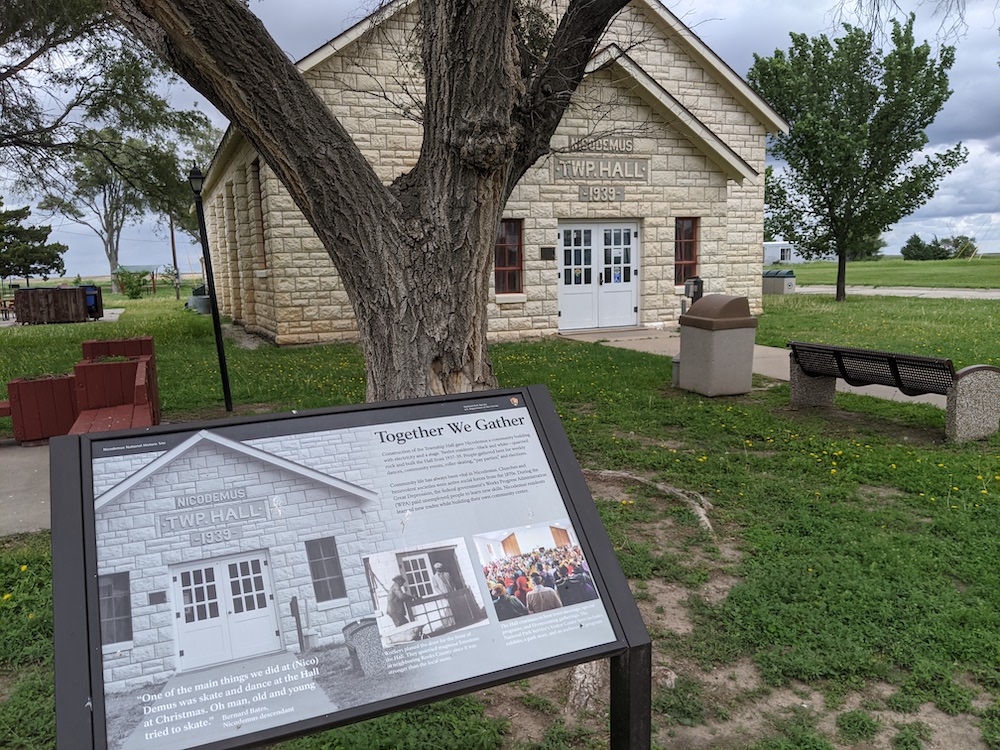
Nicodemus National Historic Site in Kansas is devoted to the story of the Exodusters. We drove up there and did this virtual tour of the place.
The circular on page 4 is shown on the left. Click on the image to see a larger version of it.
A part of Topeka, Kansas, is called Tennessee Town because it was originally settled by Exodusters from Tennessee. Click here to learn more about this.
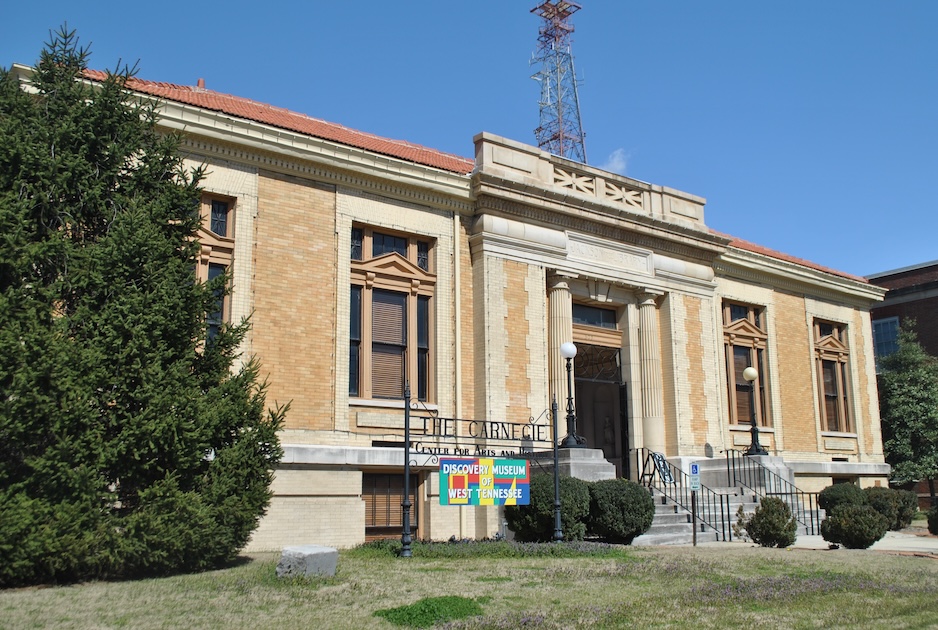
The Carnegie Library building in Jackson, Tennessee (Wikipedia photo)
SIDEBAR: “A man who dies rich dies digraced”
Standard US.09: Describe the changes in American life that resulted from the inventions and innovations of business leaders and entrepreneurs of the period and evaluate the business practices of (among others) Andrew Carnegie, John D. Rockefeller and Cornelius Vanderbilt.

The Carnegie Library building in Chattanooga (Wikipedia photo)
The purpose of this sidebar is to inform students that although business leaders of the late 19th century could be ruthless, they gave GENEROUSLY to Tennessee causes, especially the Great Smoky Mountains National Park and the Vanderbilt Medical School.
Click here to read Andrew Carnegies essay The Gospel of Wealth, in which he states (twice) that “a man who dies rich, dies disgraced.”
TN State Library and Archives photo
I once wrote a book about the history of Vanderbilt University which contains two chapters about Holland McTyeire and his connection to Cornelius Vanderbilt. It has been out of print for a long time, but if you are interested in purchasing a used copy, I think you can find one on AbeBooks.com.
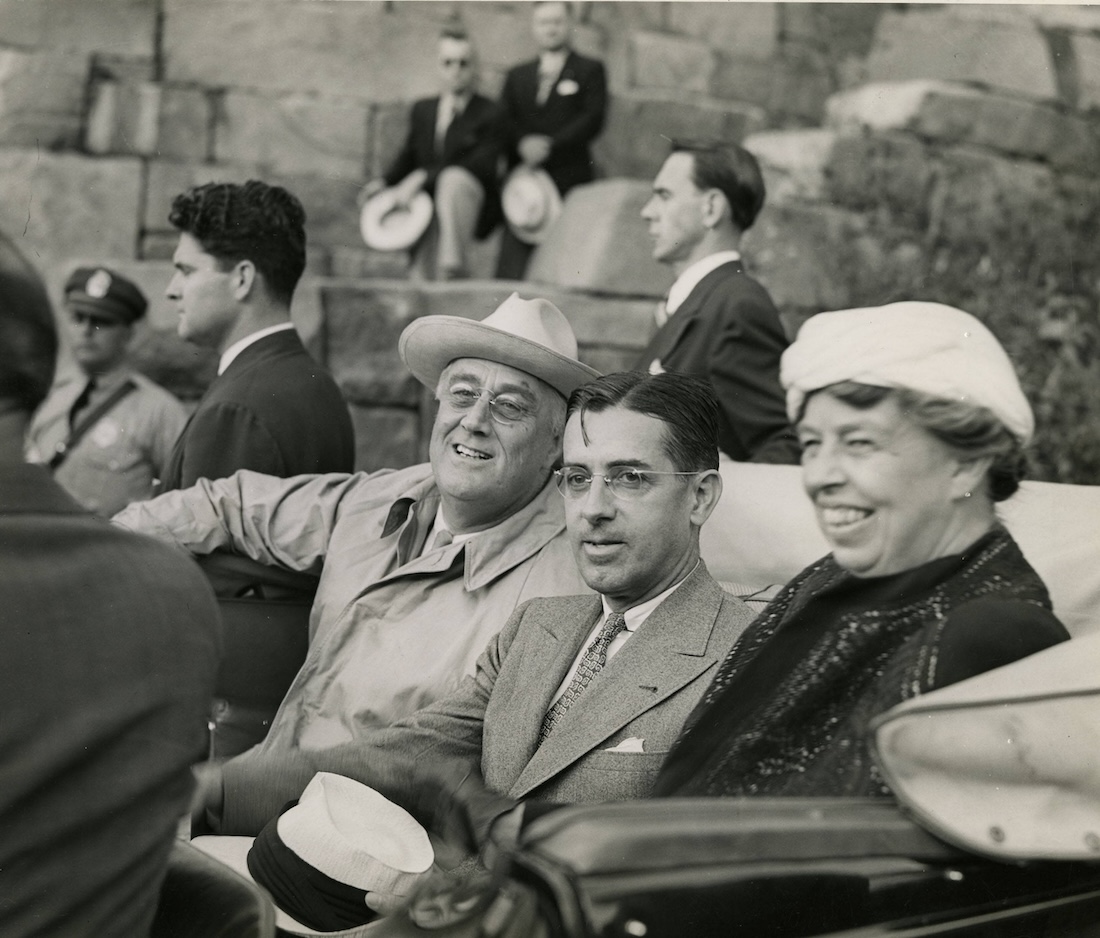
On page 6, there is a photo of President Roosevelt speaking at the dedication of the Great Smoky Mountains National Park in 1940. On the right is a photo taken a few minutes before THAT photo, which shows how President and Eleanor Roosevelt got to Newfound Gap from the airport. The man between them is Tennessee Governor Prentice Cooper. (I have a feeling Governor Cooper didn’t get a word in edgeways.)
TN State Library and Archives photo
Chapter 2: Foreign Colonies
Standard US.07: Describe the differences between “old” and “new” immigrants, including urbanization, Angel Island, Ellis Island, push-pull factors and ethic clusters.
Standard US.10: Determine the impacts of increased immigration on American society, including competition for jobs, rise of nativism, and Chinese Exclusion Act and Gentlemen’s Agreement.
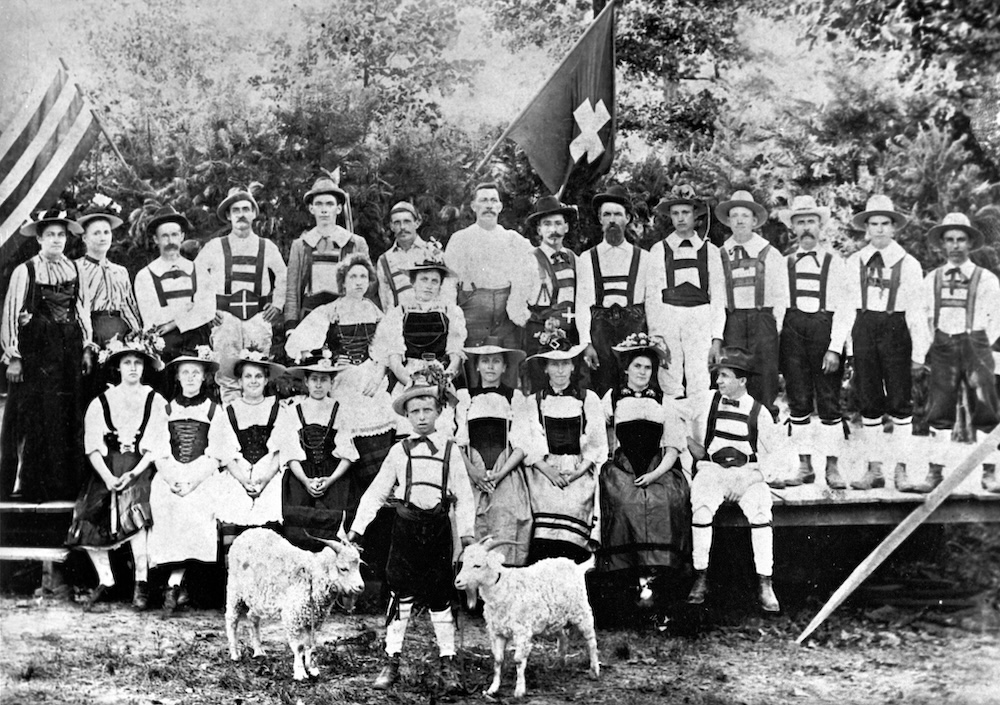
The photo on page 8 may be the best photo in the entire booklet (especially the goats in the front). Click on the image on the right to see it bigger (and it is courtesy of the TN State Library and Archives.)
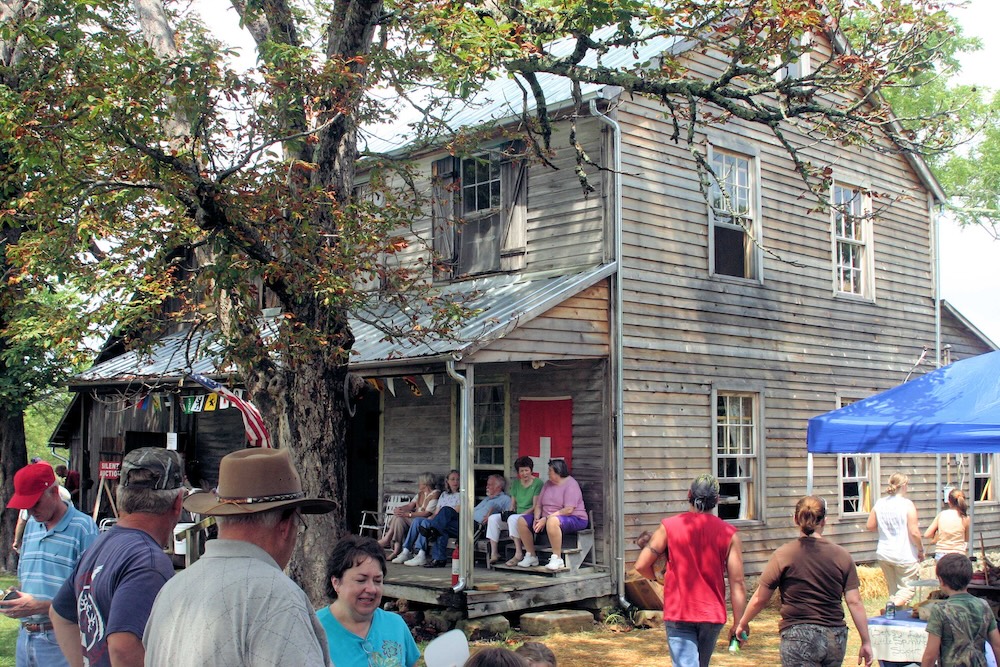
Since we printed this booklet in black and white, and since the photo on page 11 is in color, we thought we show you that as well, on the left.
Click here to be taken to the website of the Grundy County Swiss Historical Society.
Chapter 3: Children in Cotton Mills
Standard US. 13: Describe working conditions in industries during this era, including the use of women and children as a labor source.
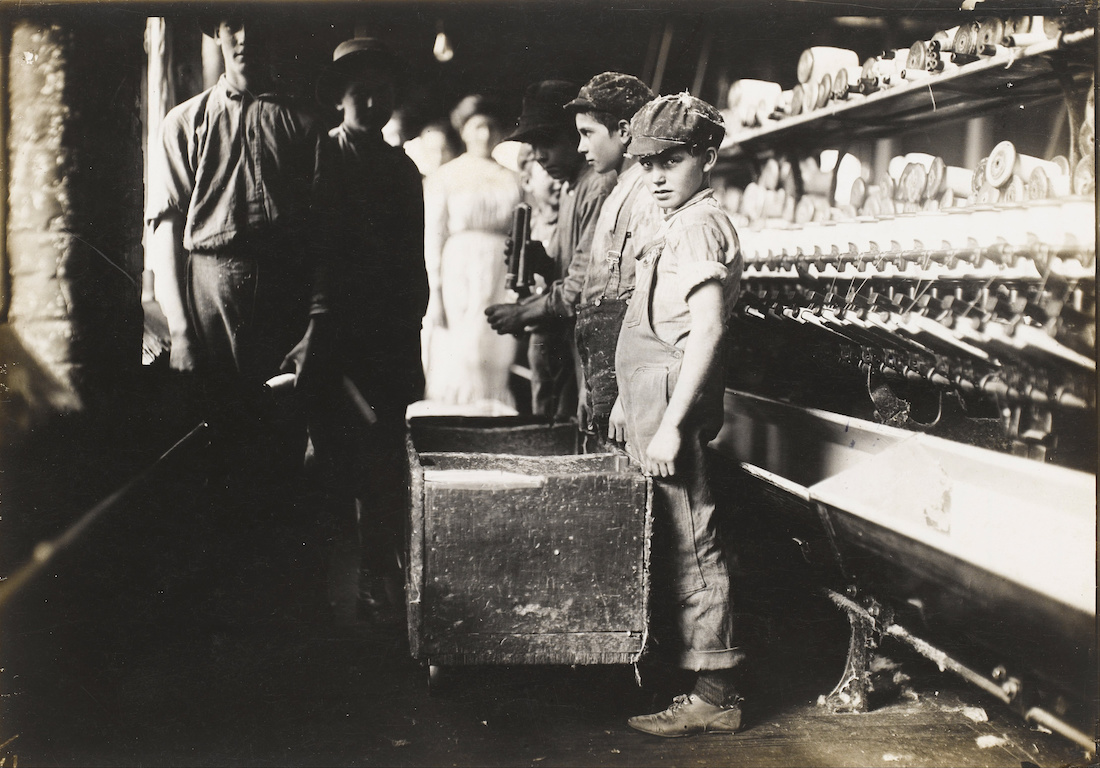
Lewis Wickes Hine photo
You won’t have trouble finding out more about Lewis Wickes Hine; click here for a website about him that is associated with the International Center of Photography.
In spite of Hine’s remarkable contribution to American history and to the welfare of children, he was not honored in his lifetime, and he died poor. I also find it very interesting that, after his death, the Museum of Modern Art did not accept his photo collection, but the George Eastman Museum did.
If you start digging on the history of some of the people and buildings which appear in some of Lewis Hines’ photographs, you really can find some very interesting stuff. For instance, the photograph on page 15 shows some young boys working in the Elk Cotton Mills. The Elk Cotton Mills building was still standing, at least as of 2017. Click here to read more about it.
Chapter 4: Old Hickory Division
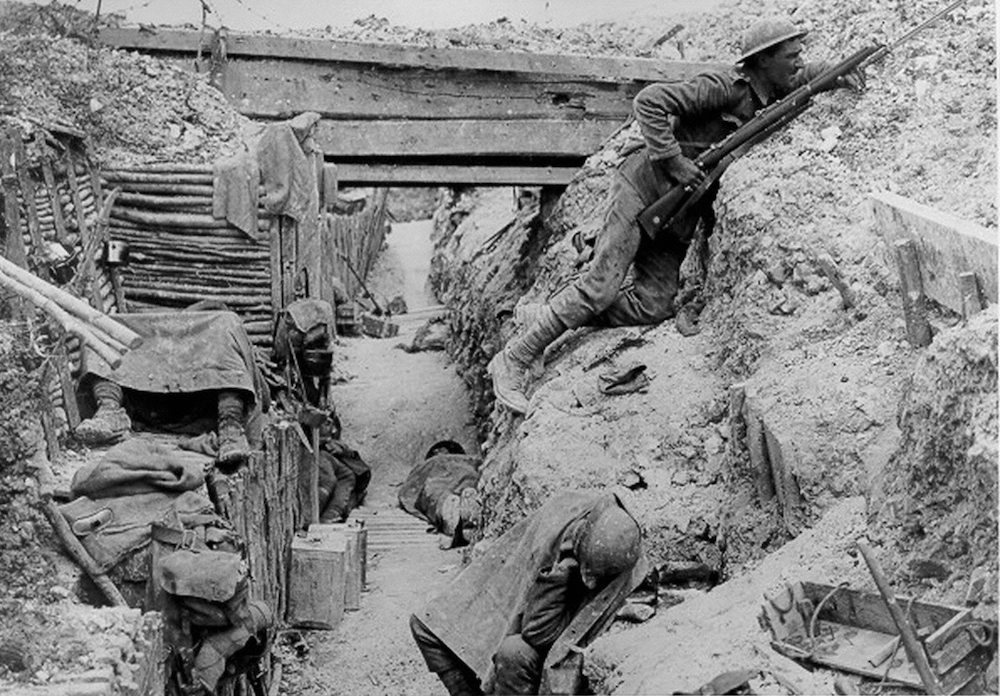
British soldiers in a World War I trench (Imperial War Museum photo)
Standard US 27: Identify and explain the impact of the following on World War I: trench warfare, use of weapons and technology, John J. Pershing, Harlem Hell Fighers and Alvin C. York.
Click here for a the TN History for Kids virtual tour of Alvin C. York Historic State Park.
In addition to the content in this chapter, I once wrote a column about World War I’s impact on Tennessee. Click here to read it.
The story about Kaiser Wilhelm’s ashtray has made its way into many national articles. Click here for a story on CBS Sportsline about it.
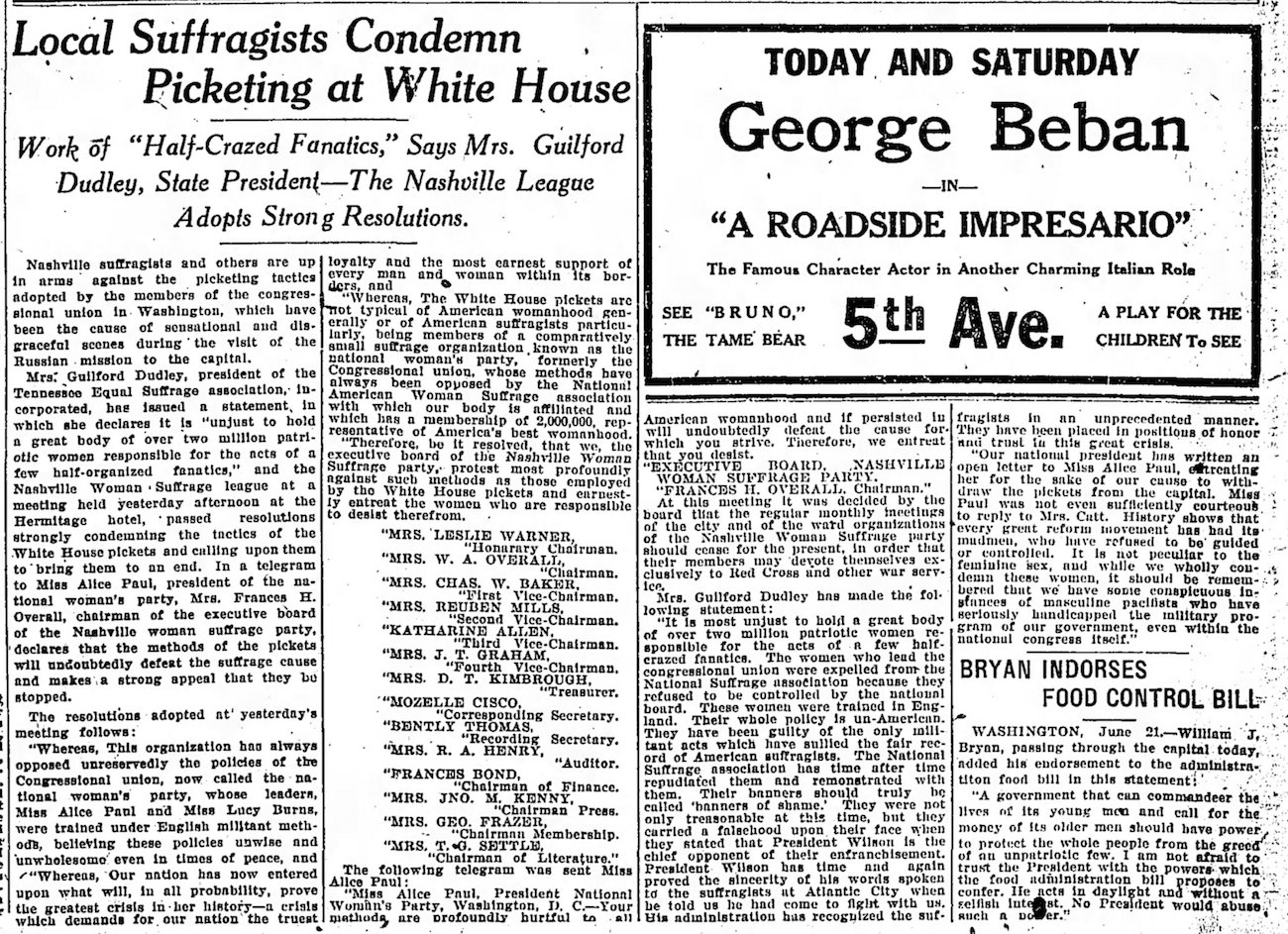
Nashville Tennessean; June 22, 1917
Chapter 5: Ladies and “Half Crazed Fanatics”
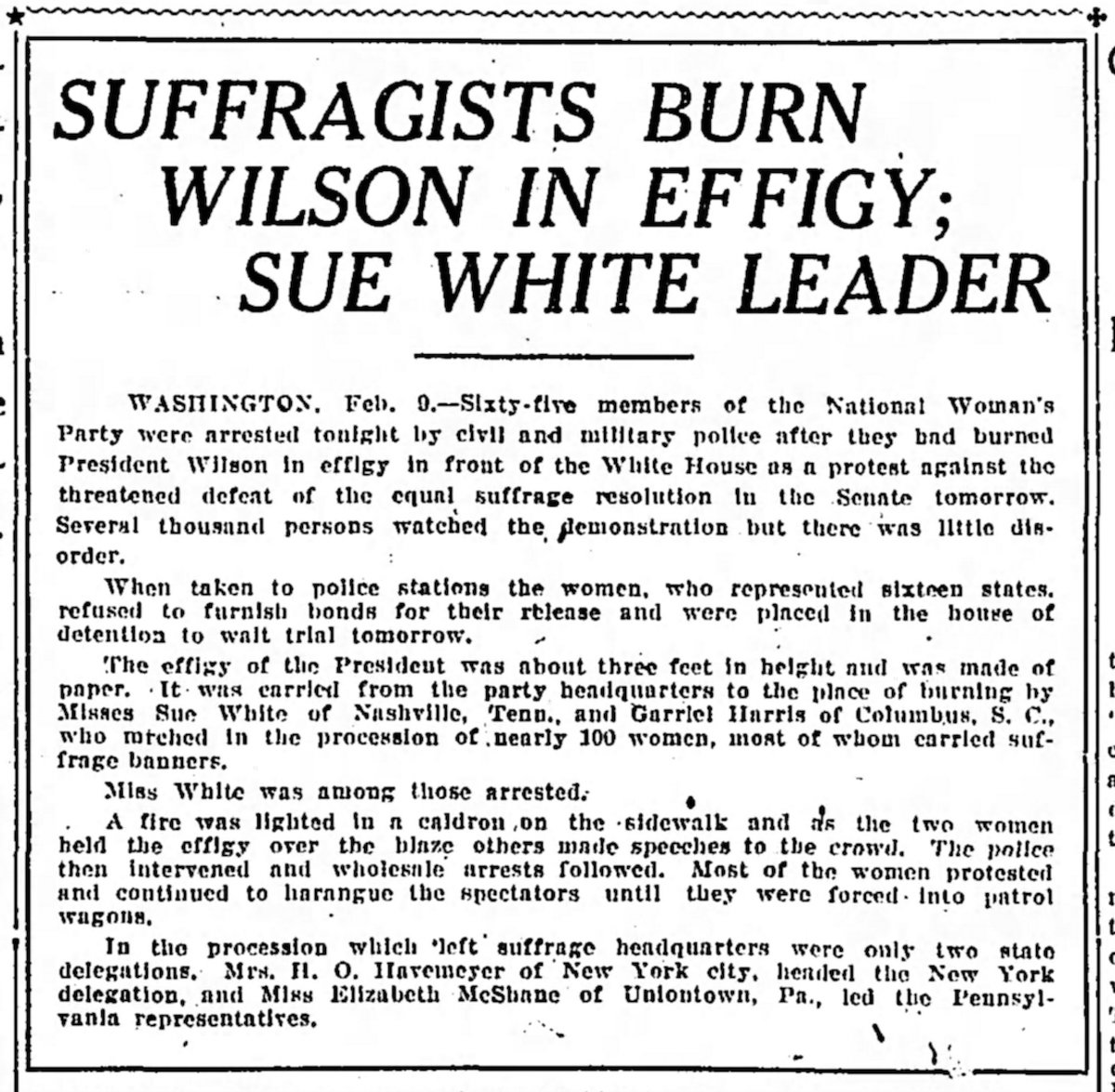
Nashville Tennessean; Feb. 20, 1919
Standard US.20: Describe the movement to achieve suffrage for women, including the significance of: Leaders such as Carrie Chapman Catt, Ann Dallas Dudley and Alice Paul; Activities of suffragists; Passing of the 19th Amendment, including the role of Tennessee; and the Legacy of Susan B. Anthony.
Click on the images on the right and the left to read two of the newspaper articles referred to in this chapter.
I can’t say enough good things about Elaine Weiss’ book The Woman’s Hour. If you have any interest whatsoever about this topic, I highly recommend that you read it.
SPECIAL PROJECT:
In 2020, on the 100th anniversary of the passage of the suffrage amendment, TN History for Kids created a series of worksheets for high school students about the suffrage movement. Each of the 9 worksheets has a quiz.
Click here to download this series of 9 worksheets.
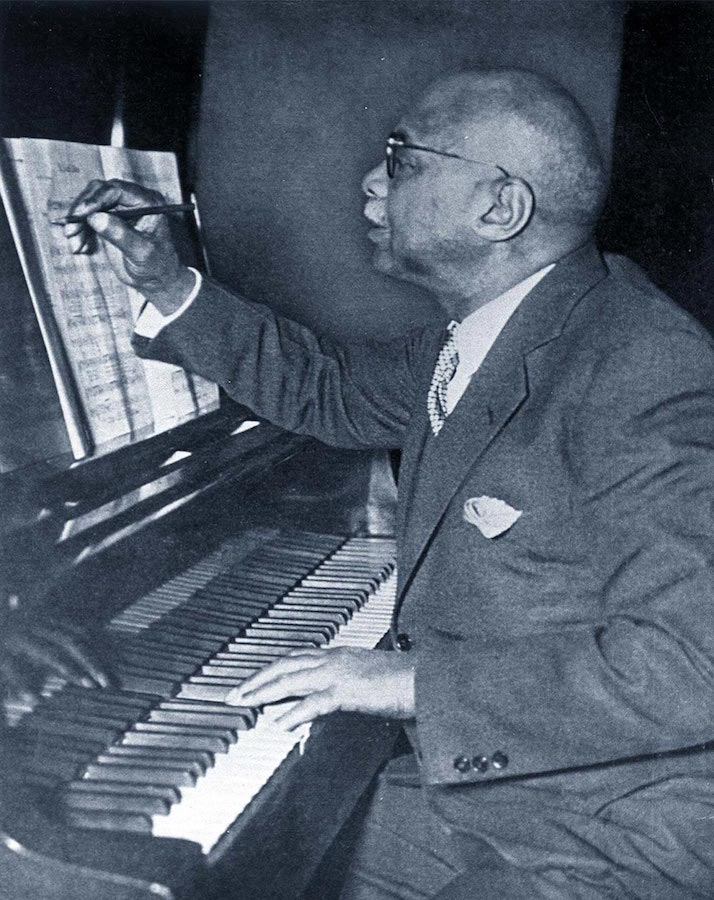
Memphis Special Collections photo
Chapter 6: Trumpet and Fiddle
Standard US.31: Describe the growth and effects that radio and movies played in the emergence of popular culture, such as advertising, celebrities, news and entertainment.
Standards US.32: Examine how the use of radio helped grow the popularity of country and blues music, including the rise of the Grand Ole Opry, W.C. Handy, and Bessie Smith.
Click here to read a column about myths and truths about the Grand Ole Opry.
Turn up the speakers and clear a space in the classroom for students to move their feet if they like! Here are some links to some of the music referred to in this chapter:

Country Music Foundation photo
* W.C. Handy “Memphis Blues”
* W.C. Handy, “St. Louis Blues”
* Humphrey Bate and his Possum Hunters, “How Many Biscuits Can You Eat?”
* Uncle Jimmy Thompson, “Lynchburg”
* DeFord Bailey, “Davidson County Blues”
Chapter 7: Cross of 300 Light Bulbs
Standard US 1: Summarize the major events of Reconstruction and explain the impact of the Compromise of 1877, including the founding of the Ku Klux Klan and lynching.
Standard US.16: Explain the roles played by muckrakers and progressive idealists, including: Jane Addams, Jacob Riis, Upton Sinclair, Lincoln Steffens, Ida Tarbell and Ida B. Wells-Barnett.
Standard US 37: Examine challenges and advancements related to the push for civil liberties, including: First Red Scare; Immigration quota act of the 1920s; Resurgence of the Ku Klux Klan; Black Wallstreet and Tulsa Massacre; Rise of the NAACP; Efforts of Ida B. Wells-Barnett; Emergence of Garveyism.
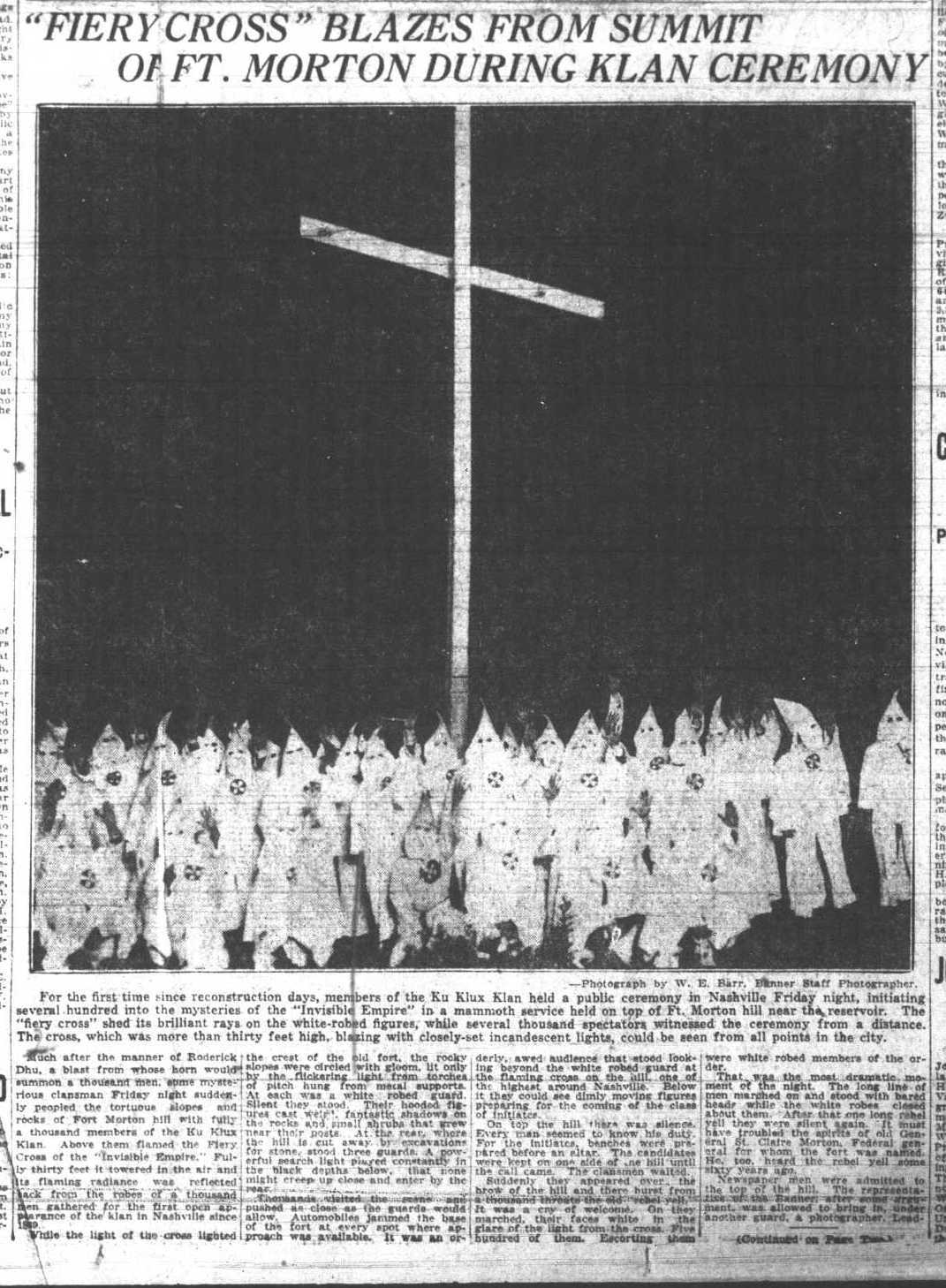 IF YOU THINK YOUR STUDENTS ARE MATURE ENOUGH TO DEAL WITH THIS, click on the right to see a front-page story and photo that appeared in the Nashville Banner on June 2, 1923. Photos didn’t accompany local news stories very much in the 1920s, but obviously it did on this occasion. The hill where this KKK meeting occurred now has Carter Lawrence Elementary School and the Belmont University baseball stadium on it.
On page 34, I try to explain the state’s use of “a large” voting districts to dilute the African-American vote. Please let me know (I can be reached at bill@tnhistoryforkids.org) if you can come up with a better way to explain this.
Click here for a virtual tour “In Search of Ida B. Wells.”
Chapter 8: Trial of the Century
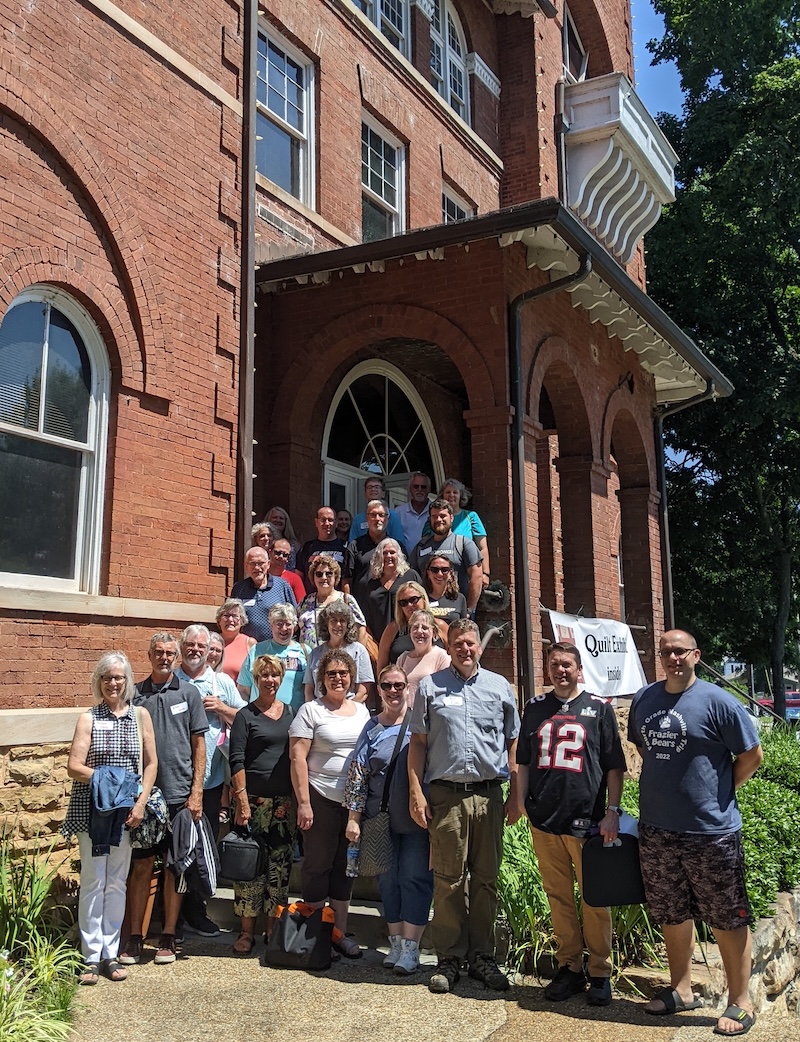
TN History for Kids held an all-day inservice at the Rhea County Courthouse in July 2022
Standard US. 38: Describe the Scopes Trial of 1925, including the major figures (John Scopes, William Jennings Bryan and Clarence Darrow), two sides of the controversy (fundamentalism and modernism), the outcome, and the legacy.
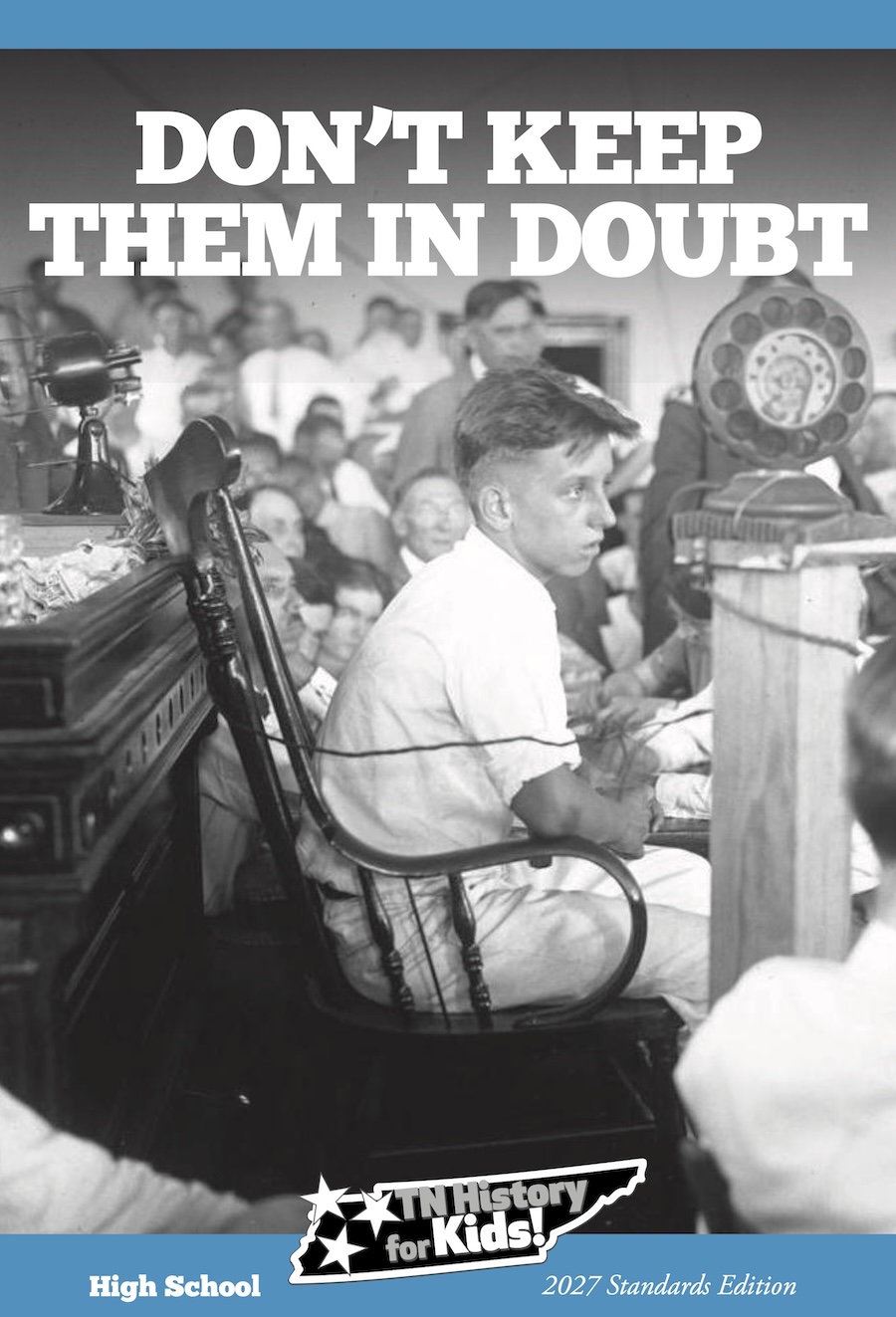
The photo on page 39, which also appears on the cover of this booklet, has never been published in print prior to the publication of this booklet. Here’s the story behind it:

THFK photo
The Chicago Tribune sent a photographer to Tennessee to take photos for the Scopes Trial. That photographer took and developed many photographs, but only a small number of them were actually printed in the Tribune during the weeks in which the Scopes Trial remained in the news. The one shown here (and also pages 41 and 42) are three of the many Scopes Trial photos which had been in the morgue of the Tribune for 90 years!
Click here to see A Civic Biology, the textbook at the center of the 1925 controversy.
I can’t say enough about the Scopes Festival, which the city of Dayton and the folks at Bryan College put on every year. Click here to check it out, and I strongly recommend going to see the drama that they put on.
Click here to see a video that Tennessee History for Kids put together about the Scopes Trial.
Chapter 9: Taming the River
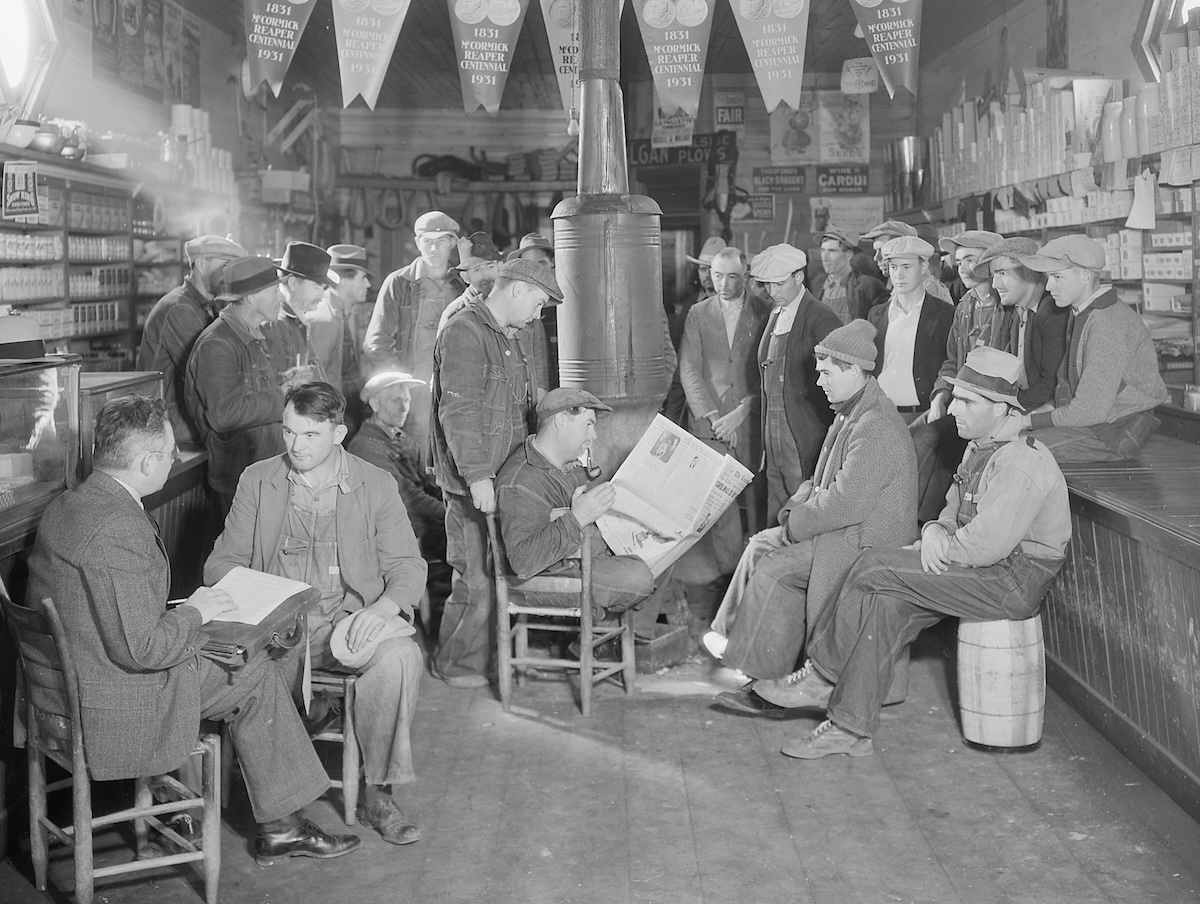
National Archives photo
Standard US.33: Describe the impact of new technologies of the era, including the advent of air travel and the spread of electricity.
Standard US.45: Analyze the impact of the relief, recovery and reform efforts of President Franklin D. Roosevelt’s New Deal programs, including: (among others): Tennessee Valley Authority,
More information about this topic on the Tennessee History for Kids website and my columns:
* Click here for a virtual tour of the Butler Museum in Johnson County.
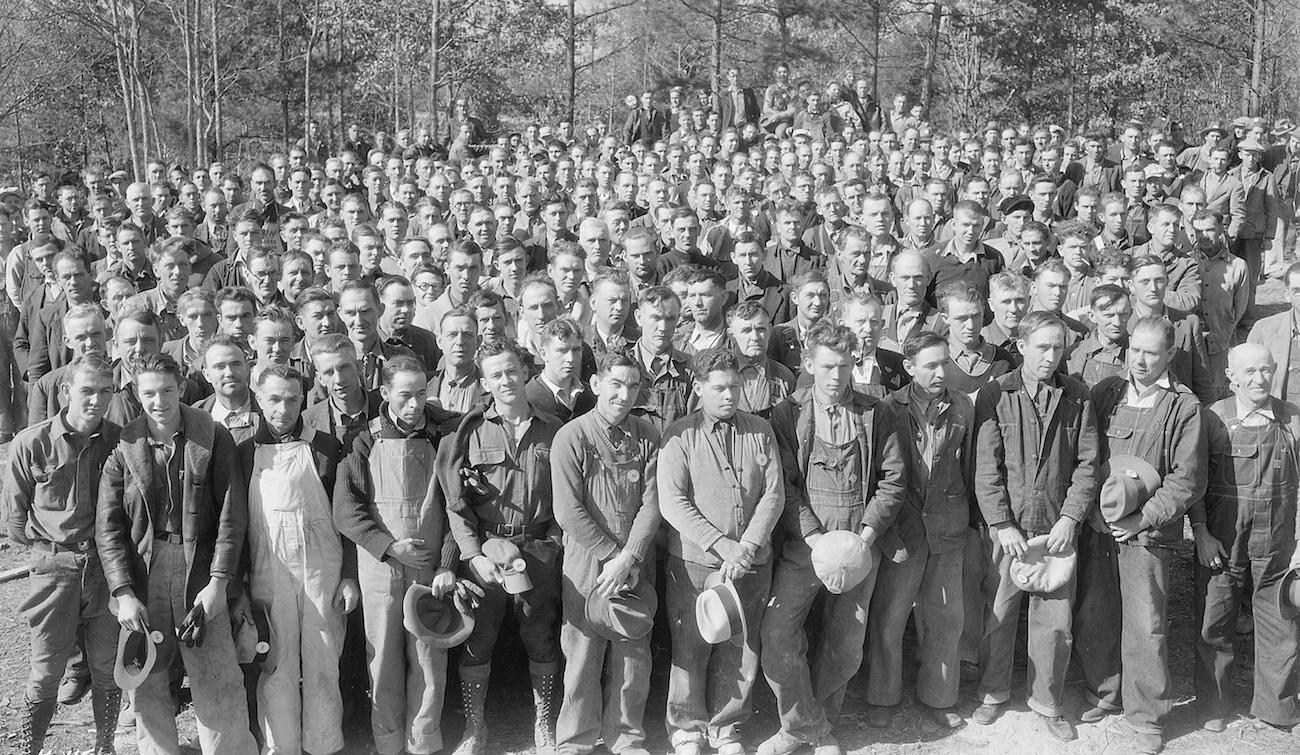
Workers at Norris Dam
* Click here for a virtual tour of Norris Dam and the area around it.
* Here for the Marion County history page.
* Here for a column about hydroelectric dams built on the Tennessee River system about a generation before TVA.
Finally, I figure that about half of Anderson County has an ancestor who appear in the photograph on page 47. Click on it (to the left) to make it larger.
Chapter 10: Planes, Maneuvers and POW Camps
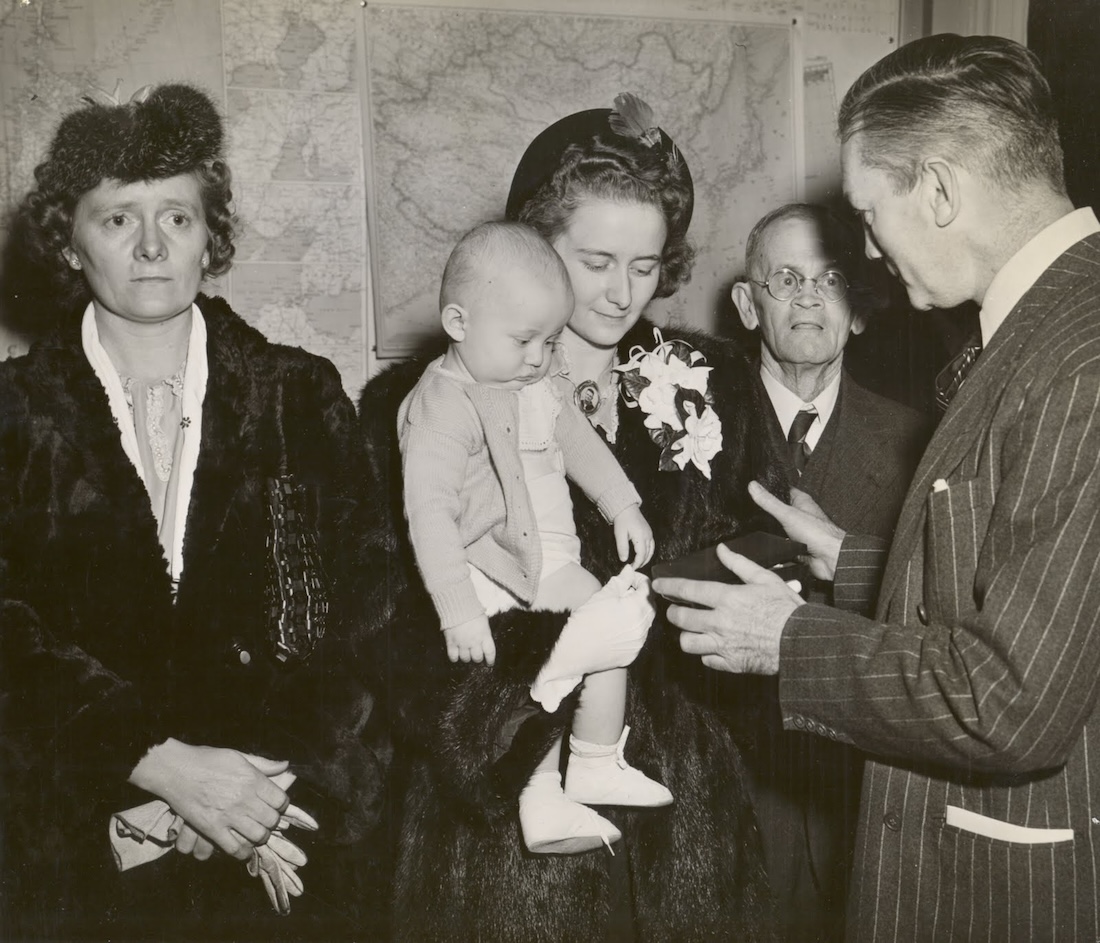
The widow and child of John Willis accept the Medal of Honor after his death (Family of John Willis photo)
Standard US.55: Describe the war’s impact on the home front, including: (among other things) conversion of factories for wartime.
I’m disappointed that the Tennessee social studies standards does not require students IN ANY GRADE to learn the name of ANY Tennessean who fought in World War II. As the great grandson of General George Patton’s chief of staff, that bothers me very much, which is why I added the content on pages 51-54.
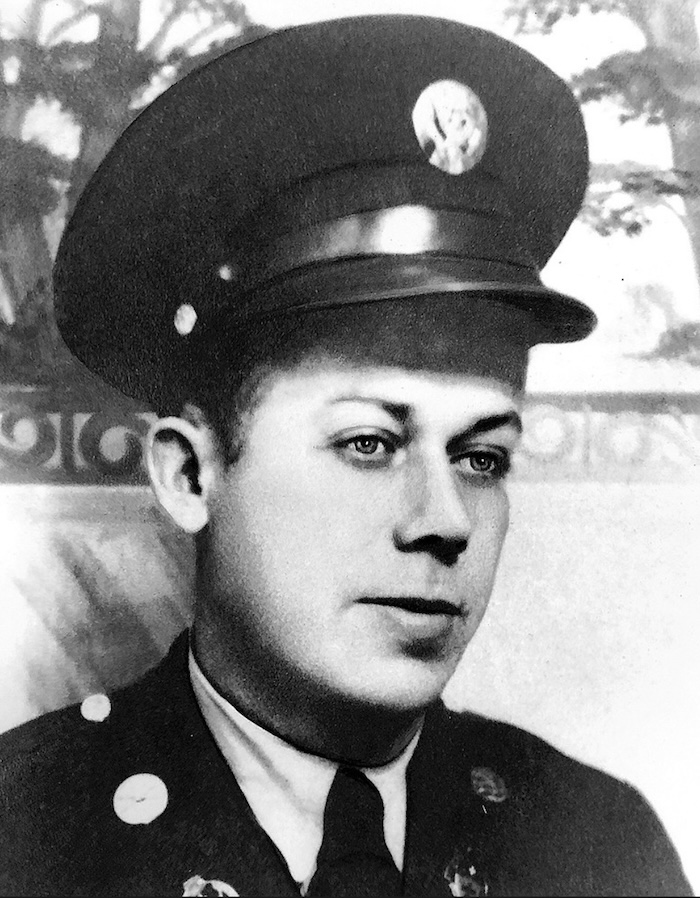
World War II Medal of Honor recipient Troy McGill was a native of Knoxville.
Click here to see more of the photos in the MTSU “Tennesseans in World War II” collection.
Click here for a column I wrote about Tennessee’s World War II Medal of Honor recipients.
Roddie Edmonds family photo
Click here to read a column I once wrote about Gerhard Hennes and Camp Crossville. I’ve been doing this column for 19 years, and this one has had more reaction, by far, than any other column I’ve ever written.
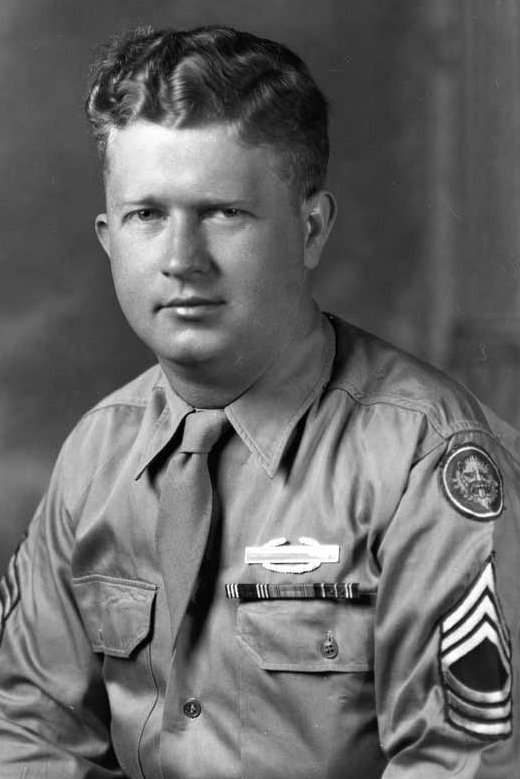
Finally, an Army Master Sergent from Knoxville named Roddie Edmonds was recently nominated for the Congressional Gold Medal for something he did in an German prisoner of war camp during World War II. Click here to read about this remarkable man’s deeds.
Click here to be taken to the website of the Smith County Historical Tourism Society, which puts on an annual World War II living history event. If you can figure out of a way for your students to go to this May event, they will love it!
Ray Smith spoke at this Tennessee History for Kids inservice in Oak Ridge in July 2021
THFK photo
Chapter 11: Secret City
Standard US.56: Describe the Manhattan Project, including Oak Ridge, Los Alamos and Hanford, and explain President Truman’s rationale for using the atomic bomb to end the war.
I need to address something in standard US.56. President Harry Truman didn’t know that using the atomic bomb would necessarily “end the war.”
Click here for a website associated with the USS Indianapolis survivors organization and here for the U.S. Naval Institute online archives of Alfred Sedivi’s photo collection.
U.S. government photo of Westcott
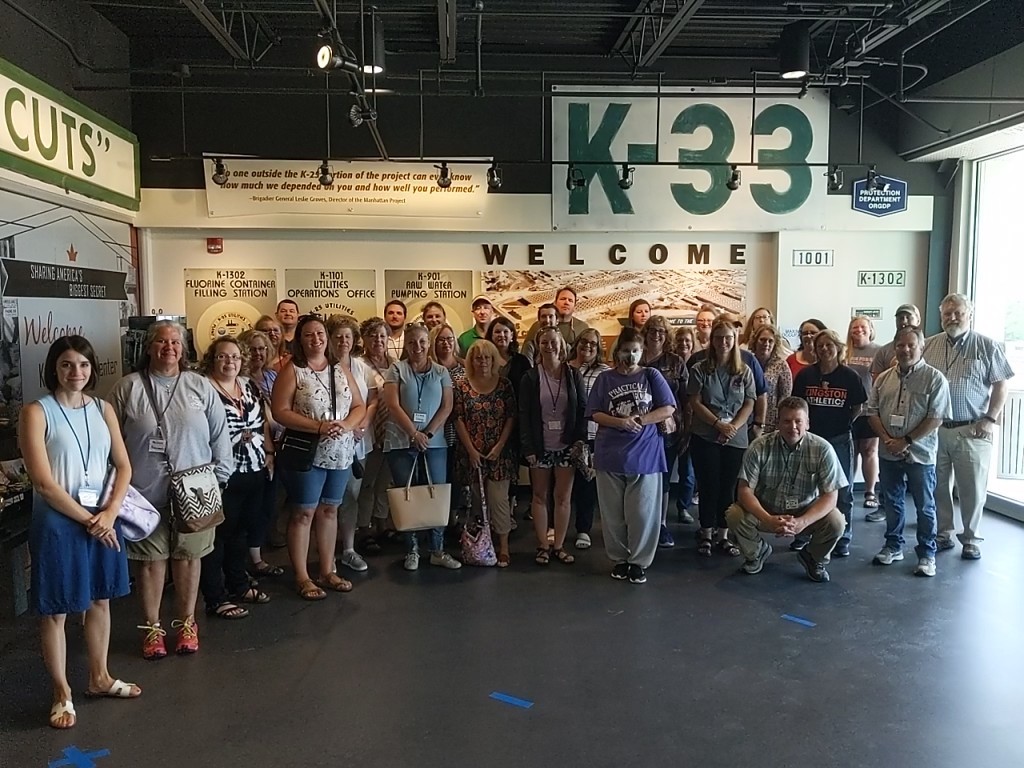
Click here for a virtual tour of the historical exhibits at the Museum of Science and Energy at Oak Ridge. I’d like to thank Oak Ridge historian Ray Smith for his help in putting this material together. Ray frequently speaks at our inservices (in-person and virtual). Stay tuned for more of this wonderful appearances!
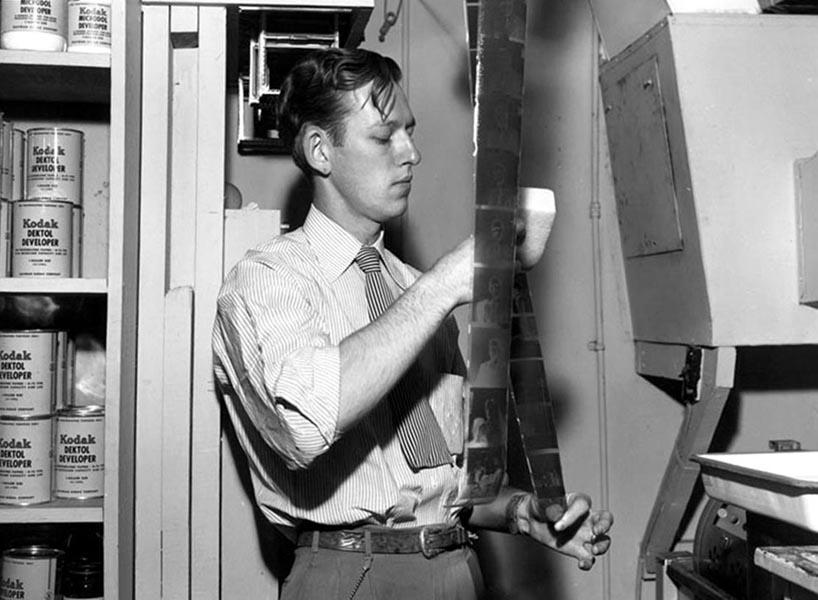
Almost all of the photographs taken at Oak Ridge during the Manhattan Project era were taken by one man–photographer Ed Westcott. Click here to see some of his photos.
Mr. Westcott died on March 29, 2019. Click here for his obituary.
U.S. government document
Chapter 12: Superhighways
Standard US.66: Describe domestic developments during Dwight D. Eisenhower’s administration, including the polio vaccine, the interstate highway system, hotel chains, and fast food chains.
Click here for a column I wrote about Citizens to Preserve Overton Park v. Volpe.
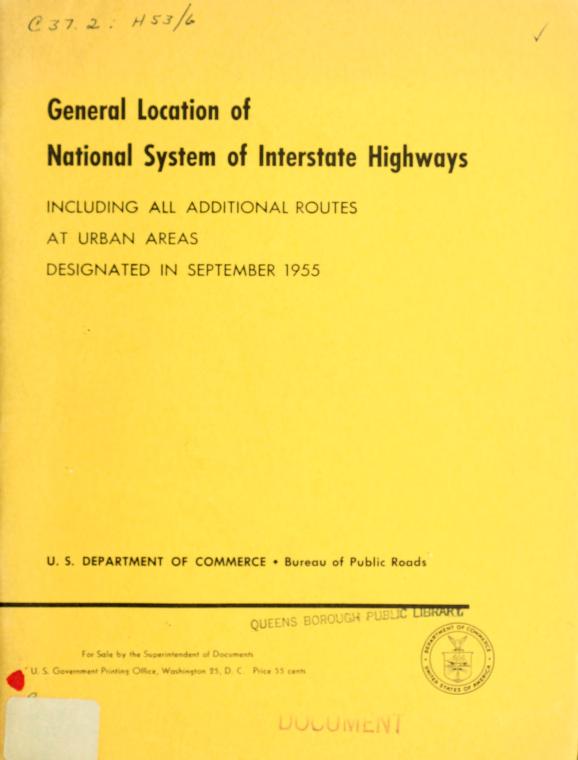
Click here to see parts of the important U.S. government document known as the “Yellow Book,” which would eventually determine where interstate corridors would go through Tennessee’s four major cities.
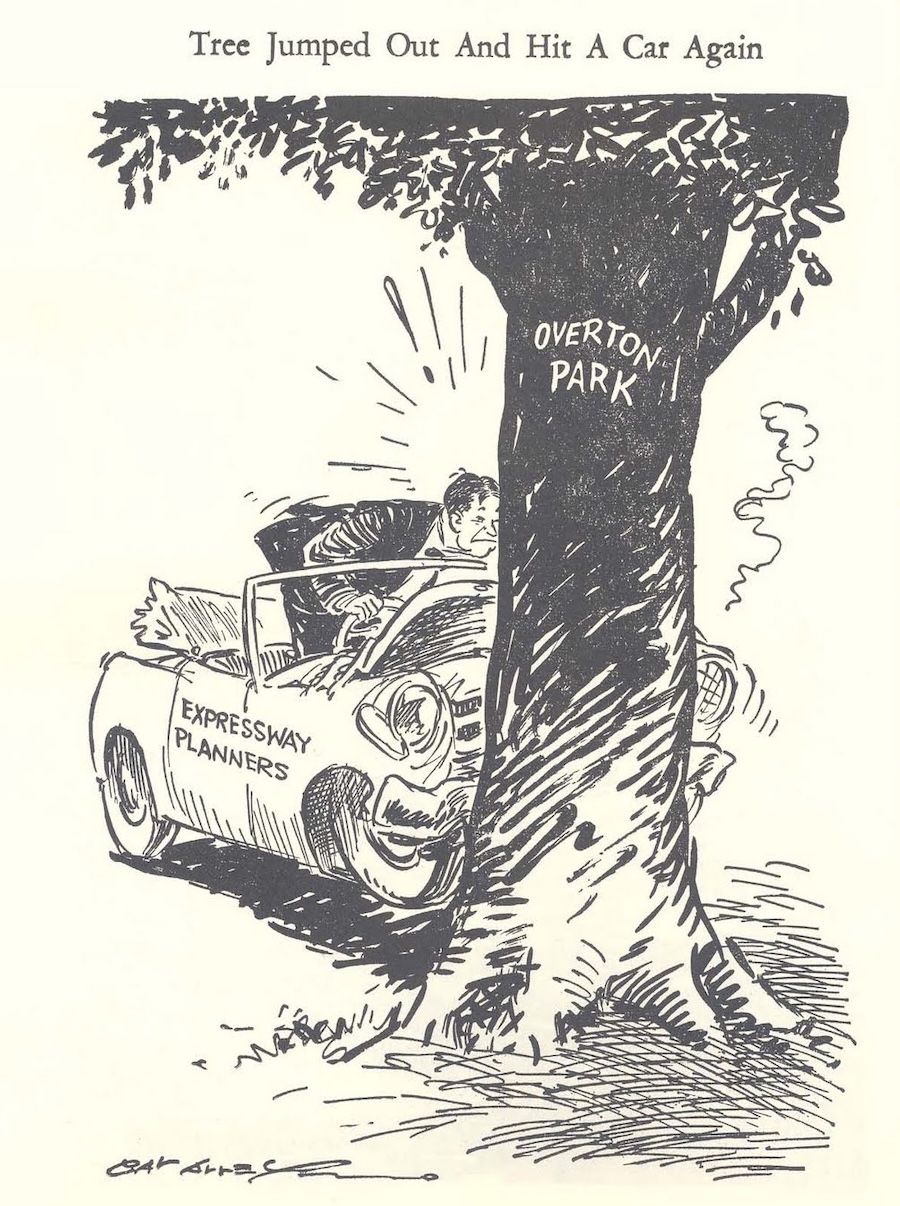
Click on the image on the left to show your students the editorial cartoon on page 67. (Obviously, students today need to know what editorial cartoons are, and they don’t have a chance to see them as much as people did in previous decades.)
SIDEBAR: Holiday Inn and the Colonel
Standard US.66: Describe domestic developments during Dwight D. Eisenhower’s administration, including the polio vaccine, the interstate highway system, hotel chains, and fast food chains.
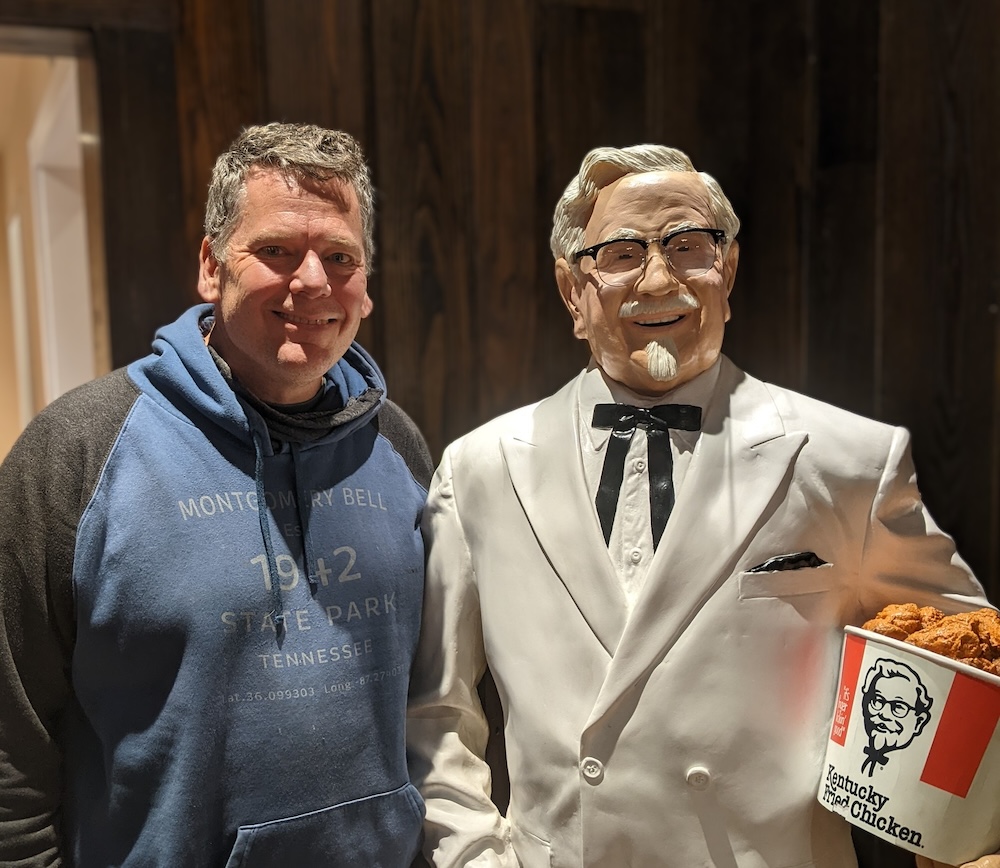
I recommend a trip to the Sanders Cafe and Museum in Corbin, Kentucky. (While there, go see Cumberland Falls — the waterfall so awesome that it forces the Cumberland River downstream to Nashville!) As you can see on the left, I visited Corbin and said hi to the Colonel.
I’m afraid I know a lot about Colonel Sanders, Jack Massey and Kentucky Fried Chicken, because I wrote two full-length books about the subject: Fortunes Fiddles and Fried Chicken: A Nashville Business History and Master of the Big Board: The Life Times and Businesses of Jack C. Massey.
However, I have to admit that I learned a lot about the Colonel at his museum.
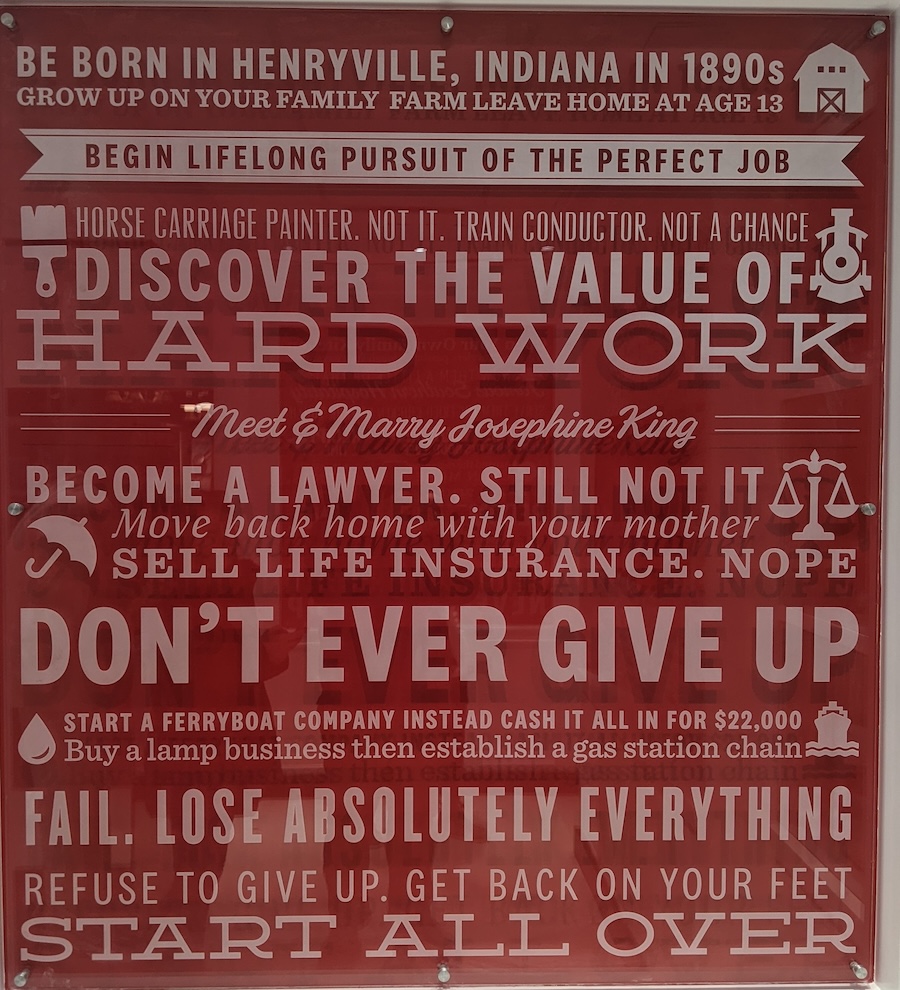
In truth, Sanders had ever reason to believe that he was a failure. The museum explains how many jobs he went through before he started his fried chicken chain — ferry operator, train conductor, life insurance salesman, lawyer, and so on.
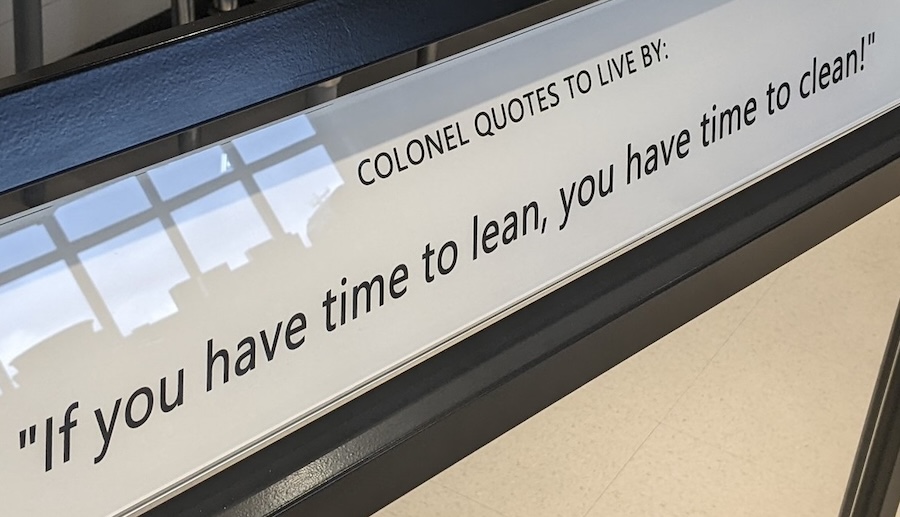
My favorite display there was the quote on the right. “If you’ve got time to lean, you’ve got time to clean.”
Chapter 13: Money from Music
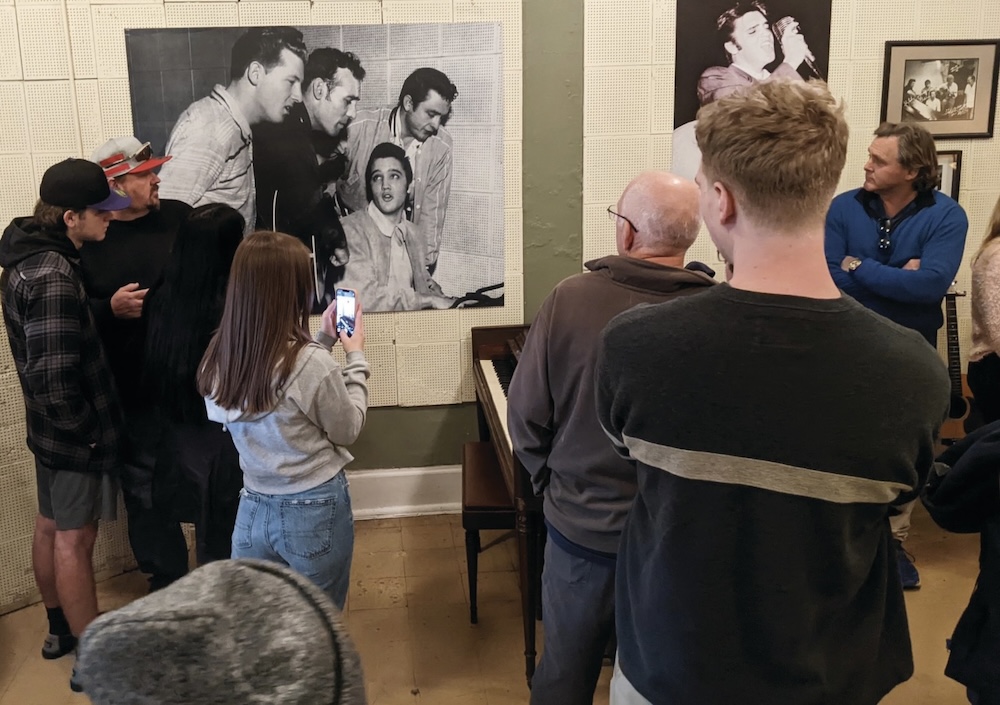
Standard US.67: Analyze the increasing impact of television and mass media on American homes, politics and the economy.
Standard US.68: Describe the emergence of a youth culture, including beatniks and the progression of popular music (from swing to rhythm and blues to rock ‘n’ roll) and the impact of Tennessee on the music industry, including the influence of B.B. King, Elvis Presley, Stax Records and Sun Studio.
Click here to read a “History Bill”-written column about how Sun Studio launched Elvis Presley’s career.

B.B. King in 2009 (Tom Beetz photo/Wikipedia)
Click here to taken to the website of the Sun Studio in Memphis and here to be taken to the website of the Stax Museum.
Ready to hear some young girls scream? Click here to see Elvis Presley performing the song “Hound Dog” on the Ed Sullivan show in 1956, and click here to read more about that appearance.
Ready to laugh? Click here to see B.B. King explain how he got his first big break, writing an advertising jingle for an over the counter medicine called Pepticon.
By the way, the Castle Recording Studio that operated in downtown Nashville in the late 1940s has nothing to do with another business that operates in Williamson County under that same name today.
Chapter 14: Highlander
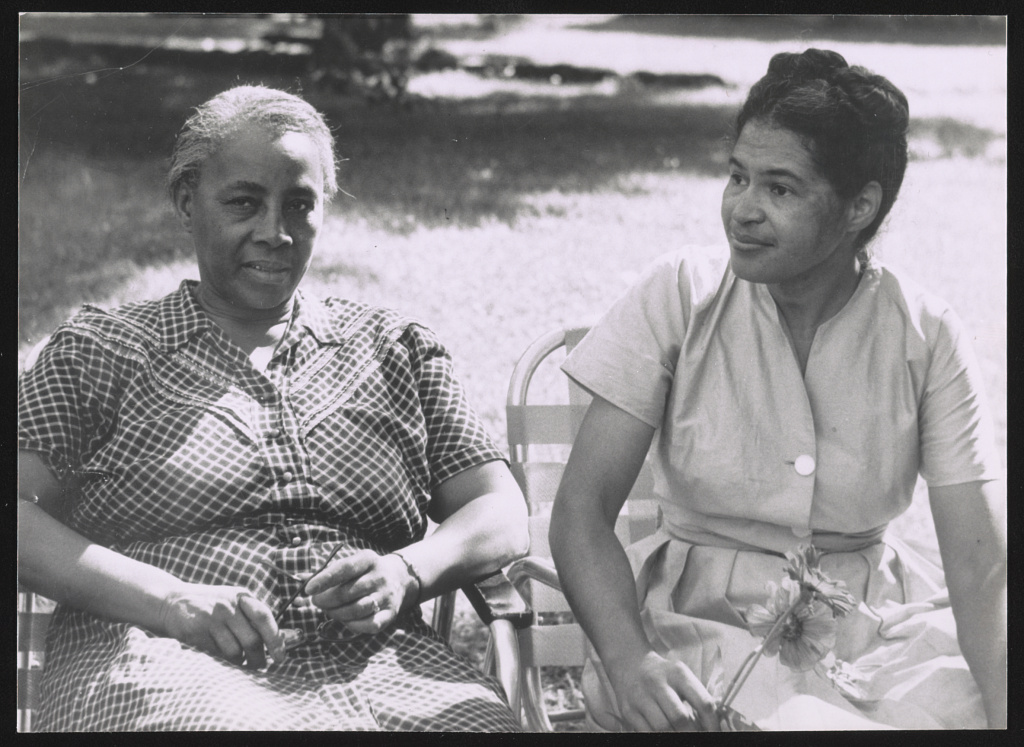
Septima Clark and Rosa Parks at Highlander Folk School (Library of Congress photo)
Standard US.76: Examine the roles and actions of civil rights activists (including Dr. Martin Luther King Jr., John Lewis, Diane Nash and Rosa Parks) and opponents.
Standard US 77: Describe the significant events in the struggle to secure civil rights for African Americans, including (among others) the Highlander Folk School and the Montgomery Bus Boycott.
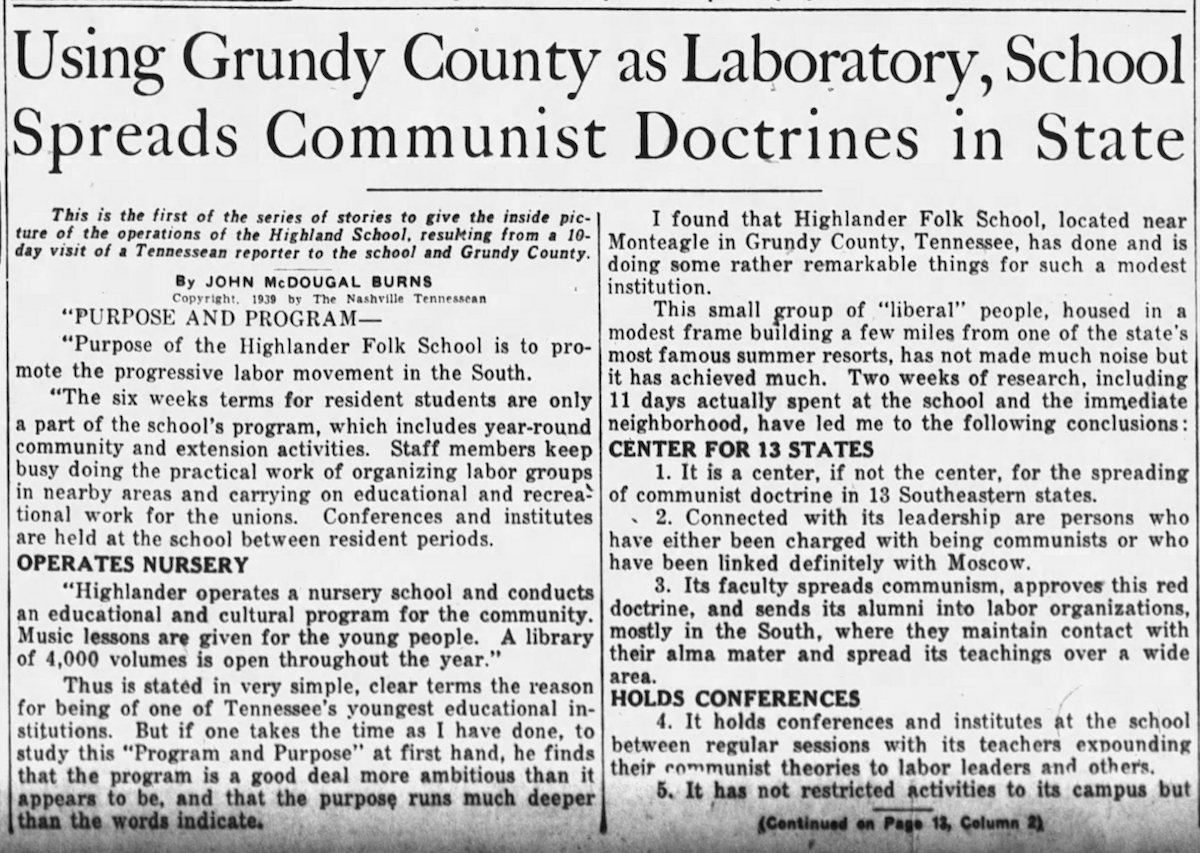
Nashville Tennessean; Oct. 15, 1939
I was not happy with how the photo on page 79 came out. Click the image on the right to see it more clearly.
Click here to be taken on a Tennessee History for Kids virtual tour “In Search of Highlander.”
Click on the image to the left to read the beginning of one of the articles about the Highlander Folk School that was published by the Nashville Tennessean in 1939.

Nashville Tennessean, Oct. 15, 1939
Click on the right to see a larger version of the image at the bottom of page 78.
This developing story: In April 2019, one of the buildings at the Highlander Education and Research Center burned in an apparent arson. A white power symbol was found on the site, raising the possibility that the fire was set by a terrorist organization. Click here to see a story about this.
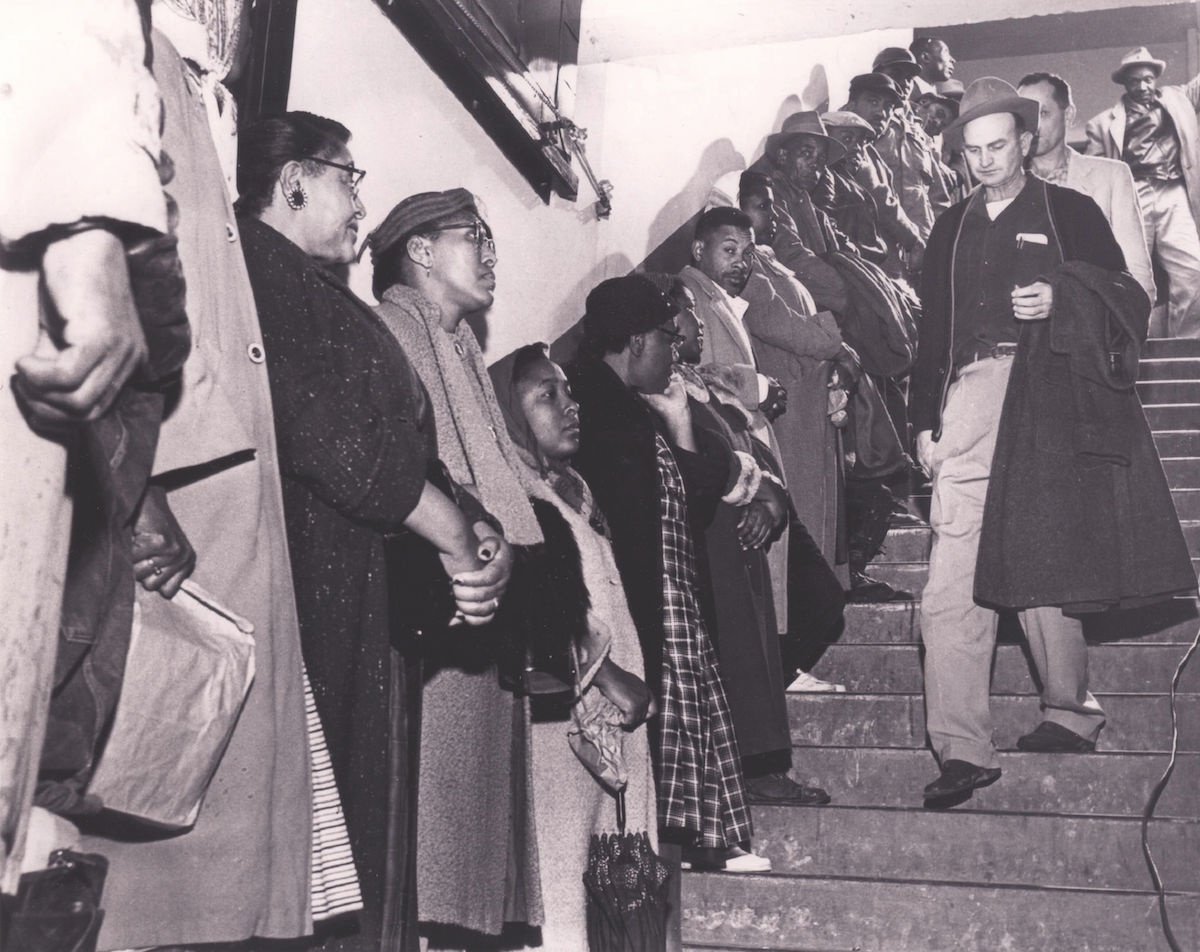
Special Collections, University of Memphis Libraries
Chapter 15: Tent City
Standard US 77: Describe the significant events in the struggle to secure civil rights for African Americans, including (among others) the Tent City [movement] of Fayette County, TN.
The best way to learn more about the Tent City Movement is from the folks at the Benjamin Hooks Institute for Social Change. Click here to explore its website.
Most of the photos that exist of the Tent City Movement, and many of the photos of the Civil Rights Movement in Memphis and Northern Mississippi, were taken by Ernest C. Withers. Today there is a gallery of Withers’ photographs on Beale Street, and you can click here to see the organization’s website.
Chapter 16: Custom of the People
THFK photo
Standard US 74: Examine the devision and impacts of Brown v Board of Education on the desegregation of schools, such as Scarboro 85, Clinton 12 and Little Rock 9.
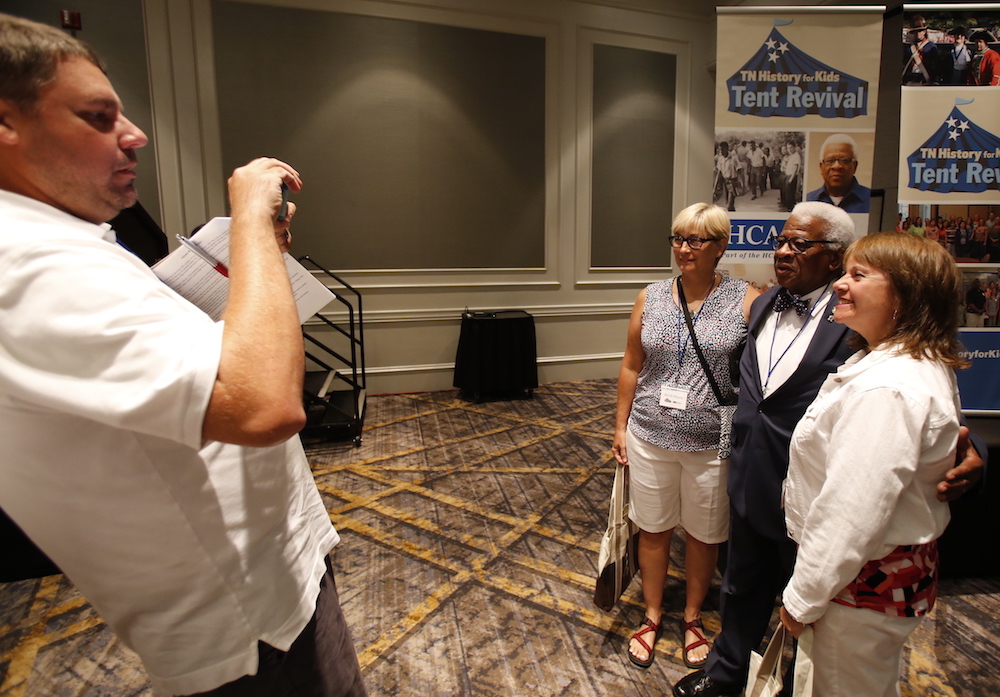
Here, on the right, is a photograph that was taken of Bobby Cain after I interviewed him on stage at the Tennessee History Tent Revival event in July 2017.
Bobby Cain died in October 2025. Click here to read his obituary written by his fraternity.
Murfreesboro Daily News Journal; Sept. 20, 1955
Click here for a public radio story about that event in which Cain was interviewed.
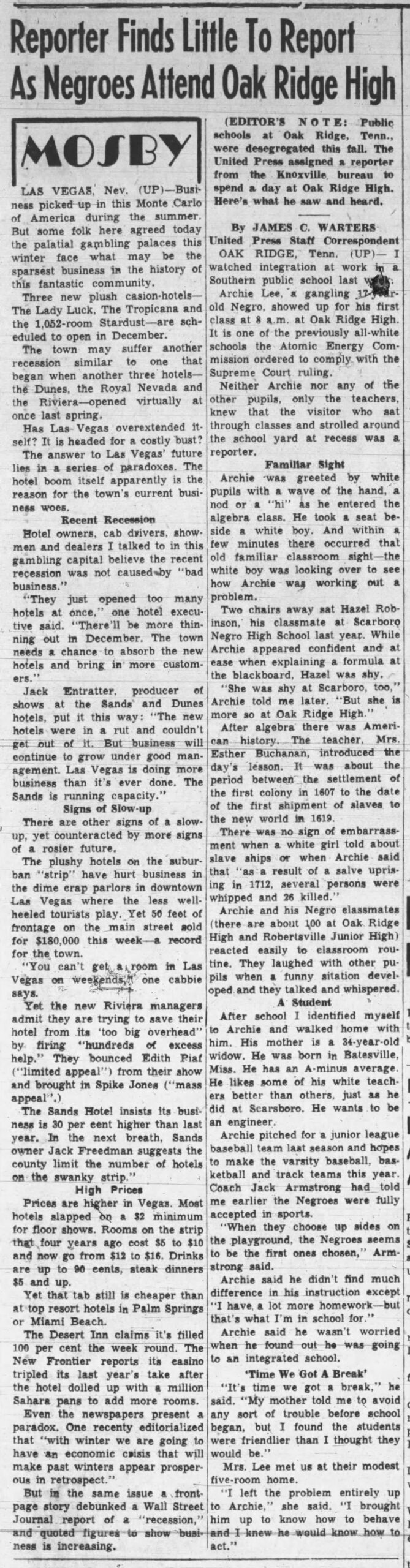
I cannot emphasize how much more publicity the desegregation of Clinton High School got as compared to the desegregation of Oak Ridge High School, a year before. Click on the right to read an article that was published in the Murfreesboro Daily News Journal that pointed out that there weren’t many fireworks when Black students first attended Oak Ridge High School.
It needs to be point out that the difference in how much publicity the high school desegregations received accounts for that fact that for many years, many history organizations — including this one — incorrectly stated that Clinton was the first public high school to de-segregate in Tennessee, when Oak Ridge was the first.
In case you are wondering, even Oak Ridge High wasn’t the first public high school in the South to desegregate. In September 1954, Franklin County, Arkansas’ Charleston High School quietly desegregated, making it the first high school in the South to desegregate.
Sidebar: Sit Ins
Standard US 77: Describe the significant events in the struggle to secure civil rights for African Americans, including (among others) the Nashville Sit-Ins.
Nashville Public Library photo
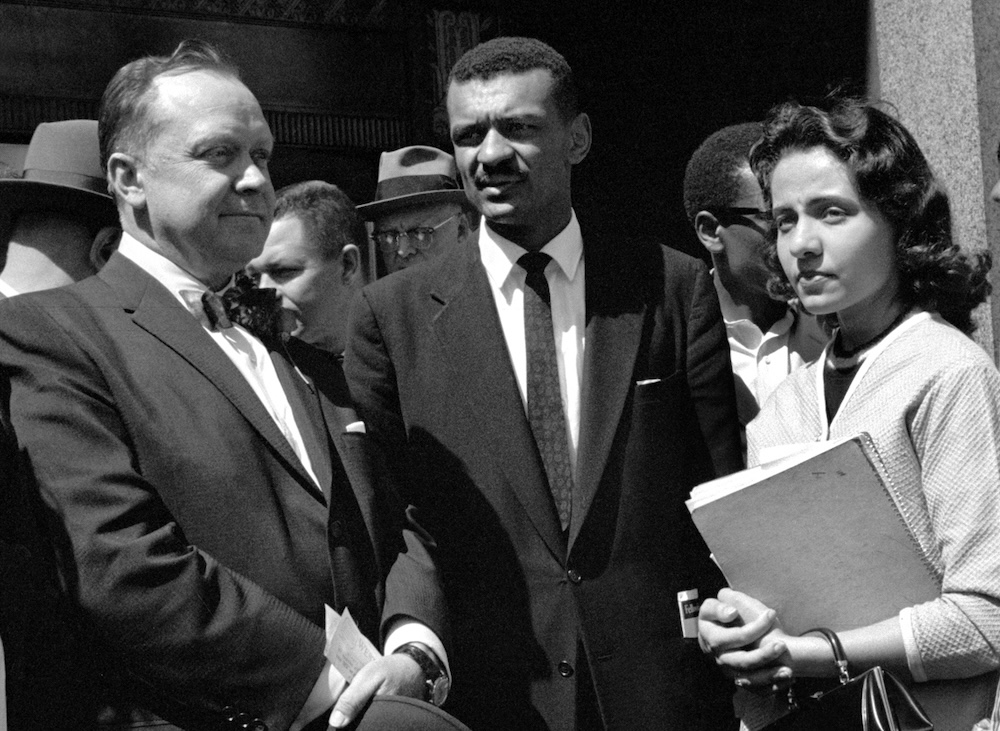
Click here for a remarkable 1960 documentary associated with the Nashville Sit-Ins which includes short interviews of some of the students, police officers, and attorneys who took part in the event.
Rather than buying a single classroom set, please consider buying one for every student. We sell these booklets for only $2.50 and print them on non-glossy paper because we want students to write in their booklets and treasure them. We believe students are more likely to value something when they are allowed to keep it.
Please do NOT copy the booklets. That is a violation of our copyright and makes it difficult for us to continue to exist. The reason we sell them for only $3.00 each is so teachers will not be tempted to copy the booklets.